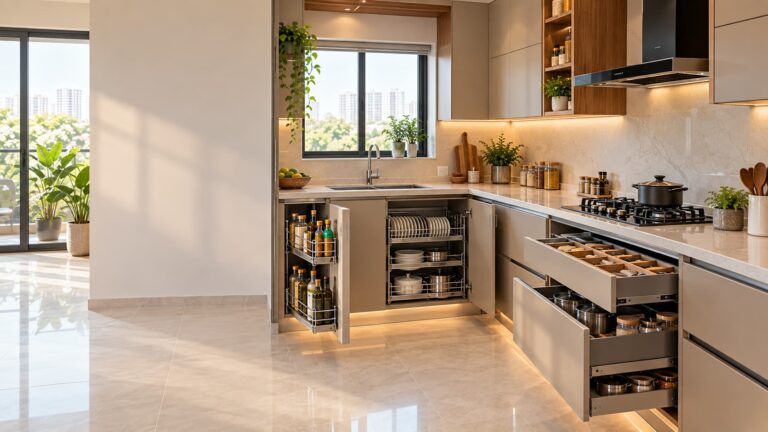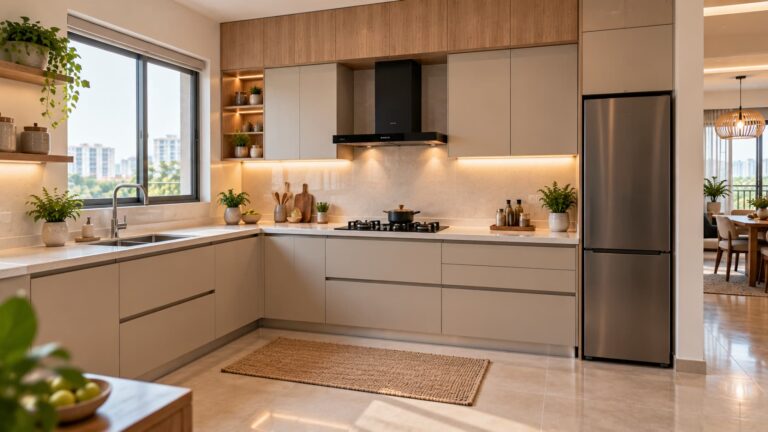
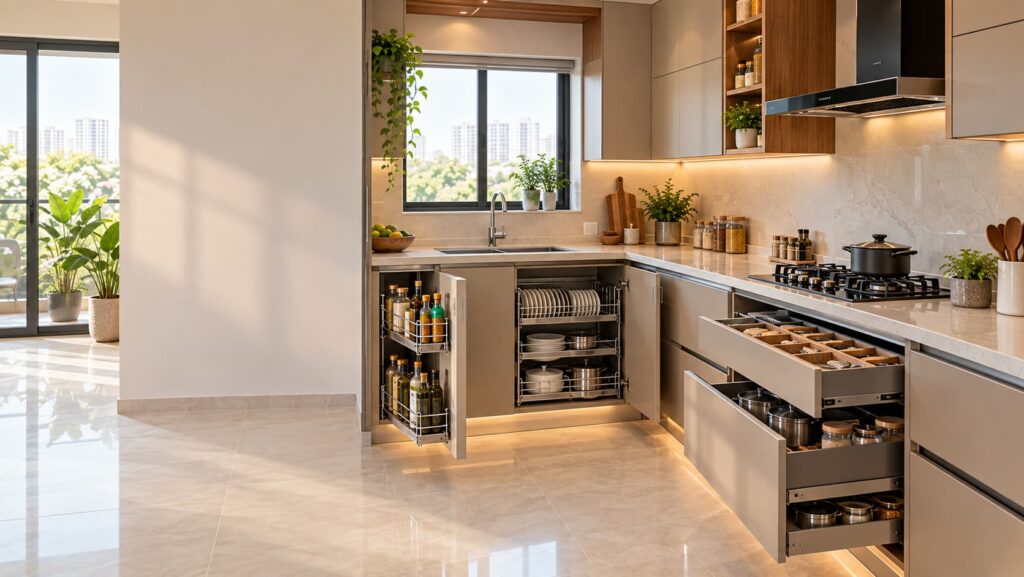
Choosing kitchen accessories can look like a small part of a modular kitchen project until you start comparing cutlery baskets, thali baskets, bottle pull-outs, pantry units, corner storage and drawer organisers. The wrong accessory can waste cabinet space just as easily as the right one can make everyday cooking easier. This modular kitchen accessories guide explains the main types, practical uses, sizing considerations, material choices and indicative Bangalore prices. More importantly, it shows how to decide which accessories your kitchen actually needs, rather than filling every cabinet with hardware simply because it is available.
What are modular kitchen accessories, and why do they matter?
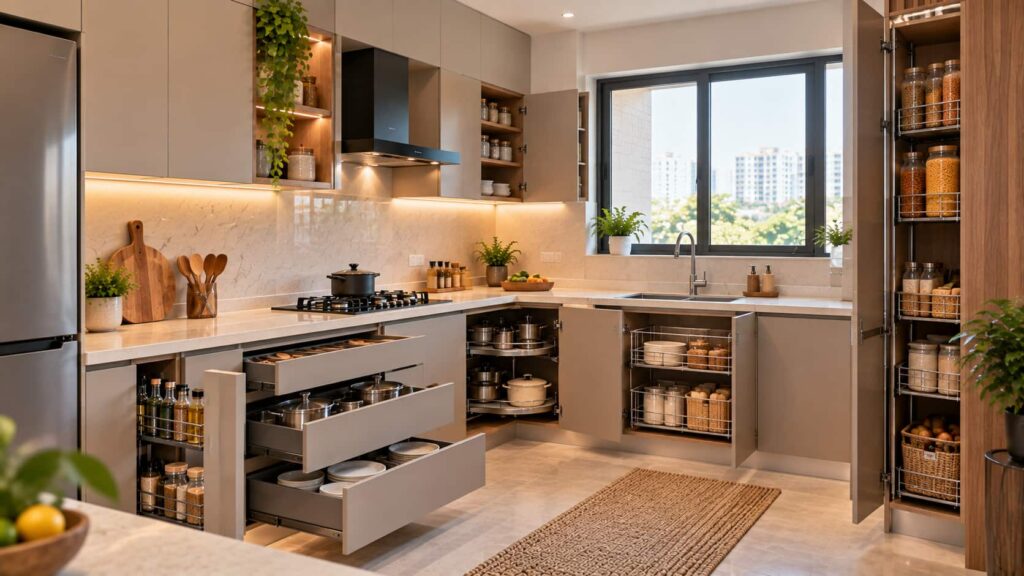
Modular kitchen accessories are the internal storage systems fitted inside cabinets and drawers to make kitchen items easier to organise and access. They include kitchen baskets, cutlery organisers, plate and thali baskets, bottle pull-outs, pantry systems, corner solutions, waste bins and drawer organisers.
The important point is that accessories should solve a storage problem. They are not automatically useful just because they make a kitchen look more sophisticated.
For example, a household that cooks Indian meals regularly may get more practical value from a combination of wide drawers, a thali or plate basket, a bottle pull-out and a well-planned pantry than from several decorative storage mechanisms.
Manufacturers and hardware specialists also offer more advanced internal organisation systems. Blum’s ORGA-LINE, for example, uses adjustable dividers and containers to organise cutlery, bottles, pots and pans inside drawers and high-fronted pull-outs.
That leads to a useful rule:
Choose the storage accessory according to what you need to store, not according to what looks impressive in a showroom.
What are the main types of kitchen baskets?
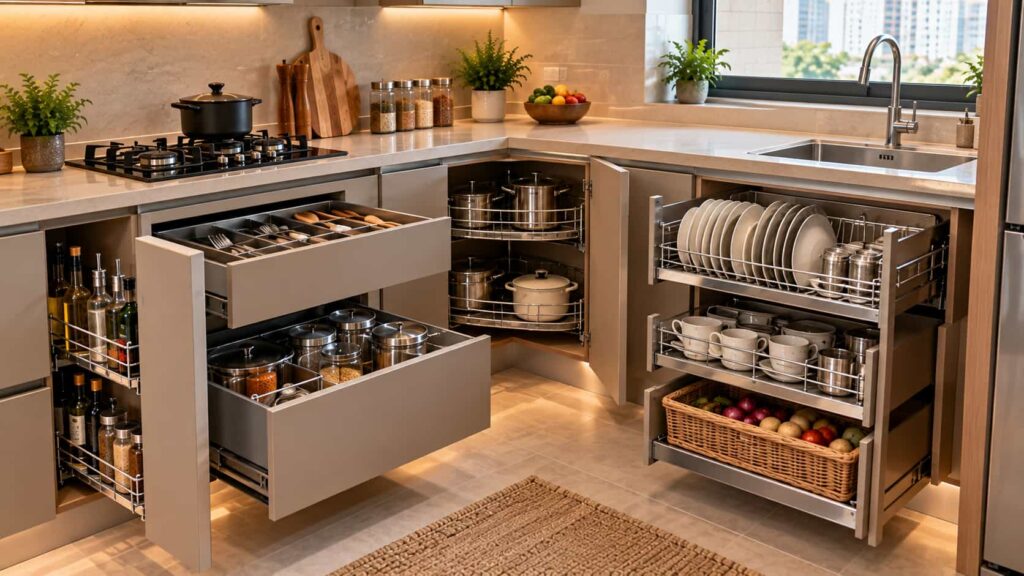
There is no single “best kitchen basket”. Different baskets are designed around different objects, cabinet widths and access requirements.
1. Plain kitchen baskets
Plain wire baskets are among the simplest modular kitchen storage options. They can be used for general-purpose storage such as utensils, containers, groceries or other kitchen items that benefit from open, ventilated storage.
They are useful when you want a straightforward basket without dedicating the cabinet to one specific category.
Stainless-steel versions are commonly available, including SS 304 products in the Indian market. Current Bangalore listings show SS 304 plain baskets alongside specialised plate, thali, cup-and-saucer and cutlery baskets.
For wet or frequently cleaned kitchen environments, material and finish deserve attention. Stainless steel can be a sensible choice, but “stainless steel” by itself does not tell you everything about thickness, construction, finish or the quality of the mounting system.
2. Cutlery baskets
Cutlery baskets or drawer organisers divide spoons, forks, knives and smaller utensils into dedicated sections.
They are best positioned where cutlery can be reached easily during food preparation or serving. A good organiser should match the drawer dimensions rather than leave large amounts of unusable space around the compartments.
This is one area where a traditional basket and a drawer organiser are not necessarily interchangeable. A drawer-based organiser can provide more flexible internal division, while a wire basket may suit a different cabinet configuration.
3. Plate baskets
Plate baskets are designed to keep plates vertically or in organised sections rather than stacking everything loosely inside a cabinet.
They can make frequently used dinnerware easier to remove, particularly when the basket is installed at a comfortable working height.
The exact dimensions vary by manufacturer. One current SS 304 product listing, for example, specifies a plate basket at 150 mm high and 505 mm deep, illustrating why product dimensions need to be checked against the cabinet rather than assumed from the name alone.
4. Thali baskets
Thali baskets are particularly useful for larger plates, thalis and serving pieces.
If your household uses several large plates or traditional Indian serving ware, a dedicated thali basket can be more convenient than forcing those items into a general basket.
A current Bangalore listing shows SS 304 thali baskets around 200 mm high and 505 mm deep in one product range, but widths vary.
The practical question is not simply whether you need a thali basket. It is whether the cabinet has been designed around the dimensions of the plates and serving pieces you actually own.
5. Cup and saucer baskets
Cup and saucer baskets have sections designed for smaller crockery.
They can be useful in households where cups, mugs and saucers need to remain organised and easy to reach. They are particularly useful when the cabinet location makes a dedicated crockery section more convenient than a deep general-purpose shelf.
6. Bottle pull-outs
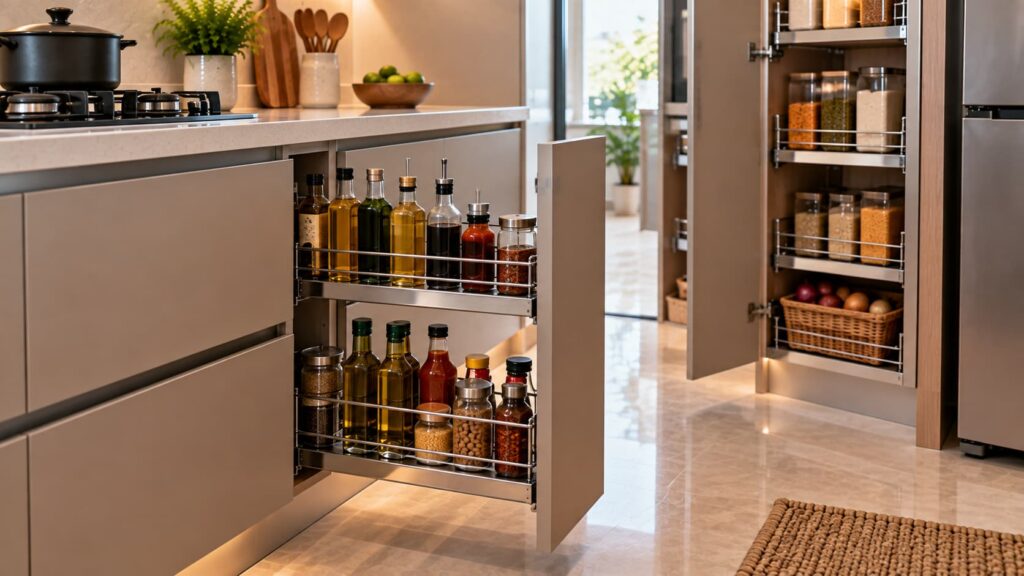
Bottle pull-outs are narrow storage units designed for oils, sauces, condiments, bottles and similar tall items.
They are especially useful because narrow spaces that might otherwise be difficult to use can become dedicated storage zones. Blum’s SPACE TWIN, for example, is designed for narrow cabinets and can accommodate bottles, spices, chopping boards and baking trays, with a stated load capacity of up to 20 kg per base cabinet.
The key consideration is width. A bottle pull-out should be planned around the available cabinet width and the size of the bottles you actually use.
7. Pantry and tall storage systems
A pantry accessory can turn a tall cabinet into a much more usable storage zone.
Instead of having groceries disappear toward the back of a deep cupboard, pull-out systems can bring different shelves or sections toward you. Blum’s SPACE TOWER, for example, uses individually accessible pull-outs and is designed for visibility and access from multiple sides. Blum states a total load capacity of up to 70 kg for the system’s pull-outs, subject to the product configuration.
This type of storage can be particularly useful for households that buy groceries in larger quantities.
However, a tall pantry is not automatically necessary in every kitchen. If your kitchen is small and your grocery storage requirements are modest, using valuable cabinet volume for an oversized pantry may not be the best allocation of space.
8. Corner storage accessories
Corners are among the easiest places to create inaccessible storage.
Depending on the kitchen layout, corner mechanisms can improve access to items that would otherwise sit at the back of an L-shaped modular kitchen or U-shaped cabinet.
But corner hardware can also be expensive and mechanically more complex than a simple cabinet shelf. Before adding one, ask whether the corner genuinely creates an access problem.
9. Waste-bin pull-outs
Waste-bin systems can keep bins inside the cabinet rather than leaving them exposed.
They are commonly placed near the sink or food-preparation zone, although the exact location depends on plumbing, cleaning routines and available cabinet space.
The important consideration is accessibility. A bin that is technically hidden but awkward to reach is not necessarily an improvement.
10. Wicker or basket-style drawer systems
Wicker baskets offer a different visual and storage approach from stainless-steel wire baskets.
Current Bangalore listings include Hettich wicker baskets in multiple widths and heights, showing that these are not one-size-fits-all products.
They can work well when you want a softer, more furniture-like storage appearance, but they should still be selected based on the cabinet’s internal dimensions, load requirements and cleaning needs.
Kitchen basket size guide: how do you choose the right size?
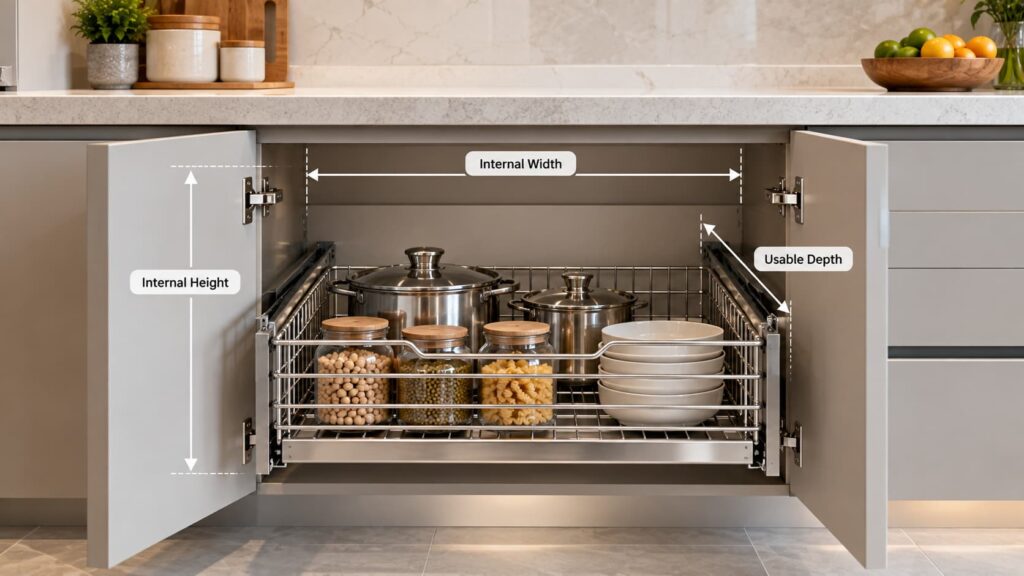
This is where many kitchen accessory purchases go wrong.
A basket labelled “600 mm” or “24 inches” does not necessarily mean you have 600 mm of usable internal space for the basket. Cabinet width, side clearances, mounting hardware, runners and the construction of the unit all affect the actual fit.
Before buying a basket, measure the usable internal cabinet dimensions, not simply the outside dimensions of the cabinet.
Check:
- Internal width
- Internal height
- Usable depth
- Door and hinge clearance
- Runner or mounting requirements
- Plumbing obstructions
- Adjacent cabinet clearance
- Required load capacity
A current 2026 basket-sizing guide similarly recommends measuring the cabinet’s internal dimensions before purchasing rather than relying on nominal cabinet size.
A simple way to think about kitchen basket sizing
If the cabinet is intended for a specialised accessory, the accessory should be selected before the cabinet dimensions are finalised, whenever possible.
This is particularly important for:
- Bottle pull-outs
- Tall pantry systems
- Tandem drawers
- Corner mechanisms
- Waste-bin systems
- Large plate or thali baskets
For a renovation or new modular kitchen, the designer and hardware specification should work together. Buying an accessory after the cabinet has already been manufactured gives you fewer options.
What are the common kitchen basket sizes?
There is no universal sizing chart that applies to every brand because different manufacturers use different mounting systems and product dimensions.
Current product ranges demonstrate the variation. For example, one Bangalore listing includes SS 304 cutlery baskets with widths around 380 mm, 430 mm, 480 mm and 530 mm, while specialised baskets use different heights and the same or different depths depending on their intended purpose.
That means a better kitchen basket size guide is based on function + available cabinet space, rather than memorising a few nominal sizes.
For example:
| Storage Requirement | Suitable Accessory |
|---|---|
| Spoons, forks and knives | Cutlery organiser/basket |
| Dinner plates | Plate basket |
| Thalis and large serving plates | Thali basket |
| Cups and saucers | Cup & saucer basket |
| Oil and sauce bottles | Bottle pull-out |
| Bulk groceries | Pantry/tall storage |
| General utensils | Plain basket or drawer |
| Kitchen waste | Pull-out waste bin |
| Difficult corners | Corner storage mechanism |
Note: The dimensions should then be confirmed against the chosen
hardware brand and the cabinet drawing.
Stainless steel kitchen baskets: what should you check?
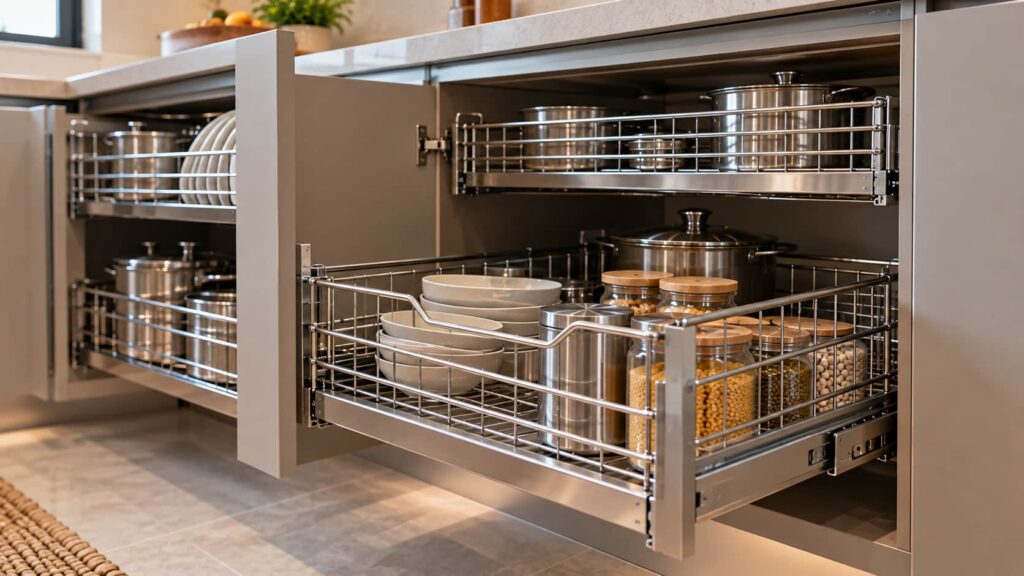
Stainless steel is a popular material for modular kitchen baskets because kitchens regularly encounter moisture, steam, food residue and cleaning.
But do not evaluate a basket only by asking, “Is it stainless steel?”
Look at the grade specified, wire or frame construction, welding quality, surface finish, mounting hardware and the runner system.
SS 304 is widely used in kitchen accessory products, and current Indian product listings include SS 304 plain, plate, thali, cup-and-saucer and cutlery baskets.
Even then, the specification should be read carefully. A stainless-steel basket can still be poorly designed or poorly installed. Similarly, the quality of the runners and mounting system affects how the accessory performs in daily use.
You should also understand the differences between common cabinet boards before finalising the kitchen, especially when comparing HDHMR vs MDF vs plywood for different applications.
How to choose kitchen baskets for a modular kitchen
The best way to choose kitchen baskets is to start with your kitchen inventory.
Think about what you use every day, what you use occasionally and what you buy in bulk.
For example, a household that cooks frequently may need accessible storage for:
- Plates and thalis
- Pressure cookers
- Pans and kadais
- Spice containers
- Oils and sauces
- Cutlery
- Groceries
- Small appliances
A household that cooks less frequently may benefit from fewer specialised accessories and more flexible drawer storage.
This distinction matters because every specialised accessory occupies cabinet space. A bottle pull-out is excellent if you have many bottles to store, but unnecessary if the cabinet could serve several other purposes.
Plan accessories by frequency of use
Keep everyday items in the easiest-to-reach locations.
Occasionally used serving ware can go higher or deeper.
Bulk groceries can be grouped in a pantry or tall unit.
Heavy cookware should generally have storage that is easy to access without repeatedly lifting it from a deep, crowded shelf.
The goal is not maximum accessories.
The goal is minimum friction in the way you use the kitchen.
Best kitchen baskets for a modular kitchen: what should you actually buy?
Rather than choosing one “best” basket, consider a combination.
For many kitchens, a practical starting configuration could include a cutlery organiser, plate or thali storage, general drawers, a bottle pull-out and some form of pantry storage. The exact mix depends on the room and household.
If the kitchen is compact, prioritise accessories that solve a genuine access problem. A narrow bottle pull-out may make better use of an awkward space than a large decorative basket.
If the kitchen is larger, a pantry or tall storage system may provide more useful capacity than filling several lower cabinets with small specialised baskets.
If the household has extensive cookware, deep drawers with suitable load-rated hardware may be more useful than multiple shallow baskets.
This is why the “best kitchen baskets” are different from one home to another.
Kitchen basket ideas for modular kitchen storage
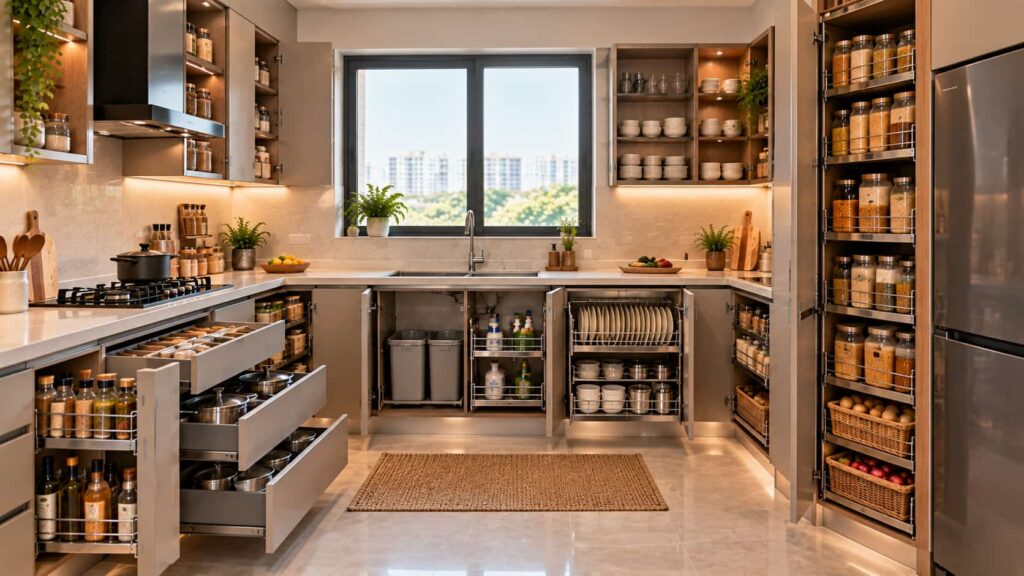
One useful approach is to divide the kitchen into storage zones.
Near the cooking area
Keep spices, oils, frequently used utensils and cookware close to the hob without overcrowding the preparation surface.
A bottle pull-out can work well for oils and sauces, while drawers can provide easier access to frequently used cookware.
Near the sink
Consider waste storage, cleaning supplies and frequently used washing accessories.
The sink cabinet requires additional attention because plumbing can reduce usable storage volume.
Near the crockery area
Plate, thali and cup-and-saucer storage can be grouped so that serving items are easy to access.
In the tall unit
Use pantry storage for groceries, containers and less frequently accessed provisions.
A tall pull-out system can make a deep storage column more accessible. Blum’s SPACE TOWER is one example of a tall storage approach designed around individually accessible pull-outs.
In drawers
Use internal organisers for cutlery, cooking tools, spices or smaller kitchen equipment.
Adjustable drawer organisation can be especially useful because the contents of a kitchen change over time.
Modular kitchen accessories price in Bangalore: how much should you budget?
If you are planning the complete kitchen budget, it is also useful to understand the overall modular kitchen cost in Bangalore rather than considering accessory costs separately.
Current Bangalore listings illustrate the spread. One 2026 price list shows products ranging from relatively simple SS 304 baskets at around ₹1,900–₹3,300 in listed examples to several thousand rupees for bottle pull-outs, wicker systems and larger mechanisms.
For example, one current listing shows:
- SS 304 plate basket: about ₹1,973 in the listed configuration
- SS 304 thali basket: about ₹1,995
- SS 304 cup & saucer basket: about ₹1,966
- SS 304 cutlery basket: about ₹3,324
- Selected bottle pull-outs: roughly ₹6,176–₹7,223 in listed configurations
These are current listed product prices, not Woodlab Interiors quotations, and prices can change with size, discounts, brand and installation requirements.
A second 2026 Bangalore price listing also shows that accessory costs can vary significantly even within the same category because dimensions and specifications change.
So if you are comparing modular kitchen accessories price in Bangalore, do not ask only for the total accessories amount.
Ask for the itemised specification.
Why two kitchen accessory quotations can have very different prices
Suppose two designers offer apparently similar kitchens.
One quotation may include basic baskets with standard runners.
Another may include branded soft-close mechanisms, heavier construction, premium drawer systems and specialised storage hardware.
The kitchens can look almost identical from the outside.
The difference becomes obvious when you open the drawers every day.
That is why a proper comparison should identify:
- Brand
- Product/model
- Material
- Dimensions
- Load capacity where relevant
- Runner type
- Soft-close mechanism
- Number of accessories
- Installation
- Warranty or service terms
A lower accessory budget is not necessarily a problem. It simply needs to be clear what specification you are receiving.
Should you buy kitchen baskets online in Bangalore?
Buying kitchen baskets online can make sense when you already know the exact product, dimensions and mounting requirements.
It is much riskier when you are still designing the kitchen.
A product listing can tell you the basket’s nominal dimensions, but it may not tell you whether it will work with your cabinet construction, door configuration, hinges, runners or available internal clearance.
Online listings currently show many different basket widths and depths even within the same product family.
For a replacement basket in an existing modular kitchen, measure first and check the exact product specification.
For a new kitchen, it is usually more practical to coordinate accessories with the cabinet design rather than purchase hardware independently and try to make the cabinet fit afterward.
Common mistakes people make when choosing modular kitchen accessories
Buying too many specialised baskets
A kitchen does not become more functional simply because every cabinet contains a different mechanism.
Specialised storage should solve a specific problem.
Choosing the basket before measuring the cabinet
Nominal cabinet widths can be misleading. Internal clearance is what matters.
Ignoring the runner system
The basket itself is only part of the mechanism. Movement, load capacity and closing behaviour depend heavily on the runner and mounting system.
Putting heavy items into unsuitable storage
Large cookware and grocery loads require appropriately designed storage. Check the manufacturer’s load rating rather than assuming every pull-out can carry the same weight.
Forgetting maintenance access
The most sophisticated accessory is not useful if plumbing, cleaning or repairs become unnecessarily difficult.
Designing around photographs
A basket that looks excellent in a showroom may not suit your kitchen dimensions or cooking habits.
Your own inventory is a better starting point than an inspiration image.
How should kitchen accessories be planned with the modular kitchen design?
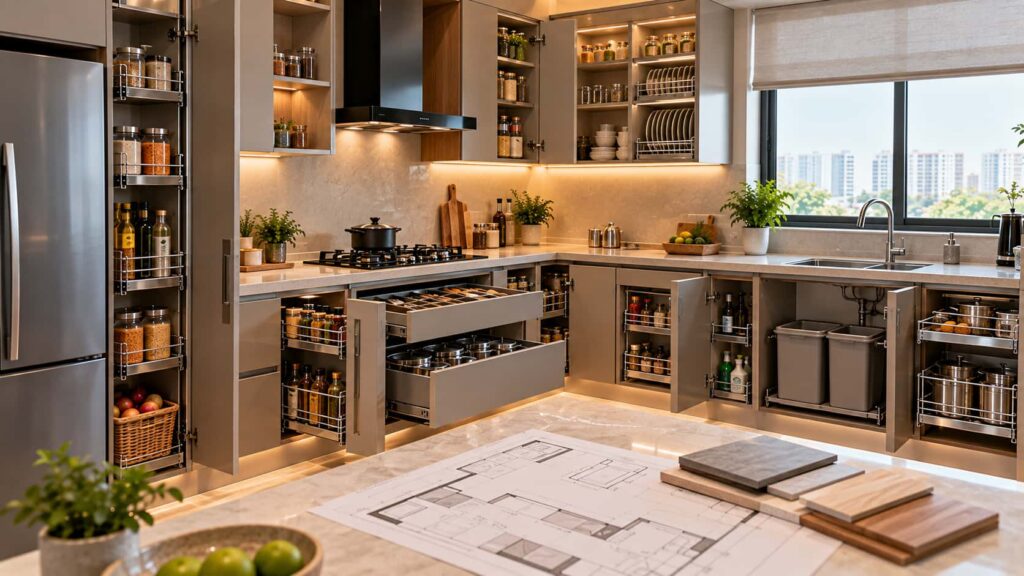
Accessories should be planned at the same time as the cabinet layout, appliances and electrical points. Before finalising the accessories, it is also useful to understand how to choose the perfect modular kitchen design based on your available space, storage needs and lifestyle.
This is particularly important because the accessory affects the cabinet width and sometimes the internal construction.
Woodlab Interiors’ current modular-kitchen content similarly emphasises planning around the room, storage needs, appliances and lifestyle rather than selecting a design from a photograph alone. Its current kitchen-related service information describes customised cabinets, storage solutions, layout planning, sourcing, manufacturing and installation.
If you are planning a new kitchen, it is useful to prepare a simple inventory before meeting a designer:
Daily use: plates, glasses, cutlery, cookware, spices and oils.
Weekly use: larger vessels, serving ware and appliances.
Occasional use: festive cookware, special serving dishes and rarely used equipment.
Bulk storage: rice, flour, pulses, packaged food and other provisions.
Once this is mapped, the designer can allocate cabinet volume according to actual use instead of distributing accessories evenly just because the kitchen has a certain number of cabinets.
Which kitchen accessories are worth prioritising on a budget?
If the budget is limited, prioritise accessories that improve daily access.
A sensible approach is to invest first in storage you will open and use repeatedly.
For many kitchens, that can mean good-quality drawer systems, a practical cutlery organiser, appropriate plate or thali storage and a bottle pull-out where the cabinet location makes it useful.
More specialised mechanisms can be added where they solve a genuine problem.
You should also avoid reducing the quality of essential hardware simply to add more accessories. A smaller number of well-specified storage systems can be more useful than a large collection of low-priority mechanisms.
The same principle applies to the rest of the kitchen. When selecting cabinet materials, it is important to consider factors such as board grade, thickness and moisture exposure, including choosing the best plywood for a modular kitchen based on the application.
How to compare a modular kitchen accessories quotation in Bangalore
Before approving a kitchen quotation, ask the designer or manufacturer to identify each accessory rather than grouping everything under “kitchen baskets”.
For example, instead of:
Kitchen accessories — ₹XX,XXX
ask for:
Cutlery basket — brand/model/size
Plate basket — brand/model/size
Bottle pull-out — brand/model/size
Waste bin — capacity/model
Drawer organiser — brand/model
Pantry system — dimensions/model
This makes it much easier to compare two proposals.
It also reduces the chance of discovering after installation that a “premium accessories” package contains a different specification from what you expected.
Woodlab Interiors currently describes its process as moving from designer consultation through booking, design finalisation, materials and installation to handover.
For Bangalore homeowners, that makes the design stage the right time to clarify accessory specifications rather than waiting until installation.
What should you ask an interior designer before finalising kitchen baskets?
Take these questions into the design meeting:
- Which accessories are included in the quotation?
- What brand and model is being proposed?
- What are the exact dimensions?
- What is the material and finish?
- What is the load capacity where applicable?
- Are the runners soft-close?
- Does the quoted price include installation?
- What happens if an accessory needs replacement later?
- Can the cabinet dimensions be adjusted to fit the chosen hardware?
- Which accessories are genuinely recommended for my cooking habits?
The final question is particularly useful.
A good kitchen plan should explain why an accessory is being used, not simply add it to the specification.
How Woodlab Interiors can help with modular kitchen accessory planning in Bangalore
Woodlab Interiors offers modular kitchen interior design in Bangalore covering layout planning, custom cabinets, storage solutions, countertops, backsplashes and installation.
The company also publishes a broader process that starts with designer consultation, followed by project booking, design finalisation, material and installation, and handover.
If you are planning a complete home rather than only a kitchen, Woodlab also provides residential interior design services, so kitchen storage can be coordinated with the rest of the home’s storage and interior planning.
For a Bangalore project, the useful next step is not to decide on ten baskets immediately. Start with your kitchen dimensions, appliance list, cooking habits and storage inventory. The accessory selection can then be built around the actual design.
Conclusion
A well-designed modular kitchen does not need the maximum number of accessories. It needs the right accessories in the right places. Start by measuring the available cabinet space, listing what your household actually stores, and separating everyday items from occasional and bulk-use items. Then compare basket material, dimensions, runners, load capacity and total installed cost rather than choosing purely by appearance or headline price. For a new Bangalore kitchen, planning the accessories alongside the cabinet layout is especially important because the hardware and cabinet dimensions need to work together. The best storage system is the one that quietly makes your daily routine easier.
Frequently asked questions
Which kitchen basket is best for a modular kitchen?
There is no single best basket for every kitchen. Cutlery baskets suit small utensils, plate and thali baskets suit crockery, bottle pull-outs suit narrow bottle storage, and pantry systems suit bulk groceries. The right combination depends on your cabinet dimensions and storage habits.
Are stainless steel kitchen baskets better?
Stainless steel is a popular choice because it is suitable for a kitchen environment and many Indian manufacturers offer SS 304 basket systems. But grade alone should not determine the purchase. Check construction, finish, dimensions, runners and mounting quality as well.
What size kitchen basket should I buy?
Measure the usable internal width, height and depth of the cabinet first. Then check the manufacturer’s installation dimensions and clearance requirements. Do not select a basket based only on the outside width of the cabinet.
How much do kitchen baskets cost in Bangalore?
Current Bangalore listings show substantial variation by type and specification. Examples in 2026 listings include roughly ₹1,900–₹3,300 for several SS 304 basket configurations and ₹6,000–₹7,200 or more for some bottle pull-outs. These are market listing examples, not a universal price list or Woodlab Interiors quotation.
Can I buy modular kitchen baskets online?
Yes. Online retailers sell individual baskets and kitchen hardware in many sizes. However, confirm exact dimensions and mounting requirements before ordering, especially if you are fitting the basket into an existing cabinet.
How many kitchen baskets do I need?
There is no standard number. Start with the items you need to store and identify the cabinets where access is difficult. Then add accessories only where they improve organisation or accessibility.
Are pull-out baskets worth the cost?
They can be, particularly when they make deep or narrow storage significantly easier to access. But the value depends on how often you use the cabinet and what it stores. A pull-out that solves a genuine access problem is usually more useful than one installed simply because it is available.