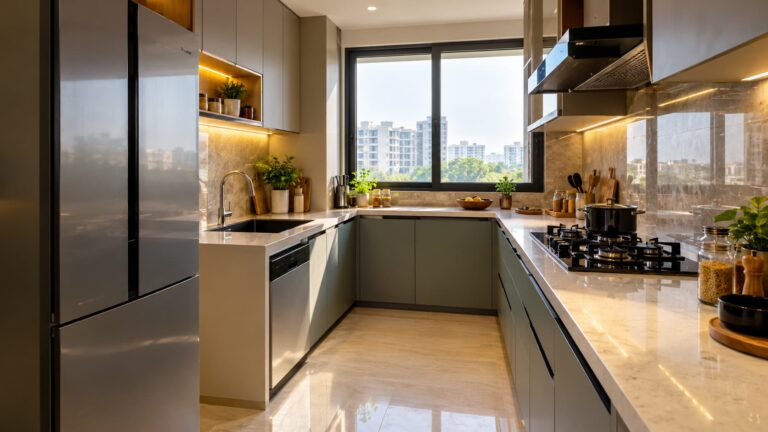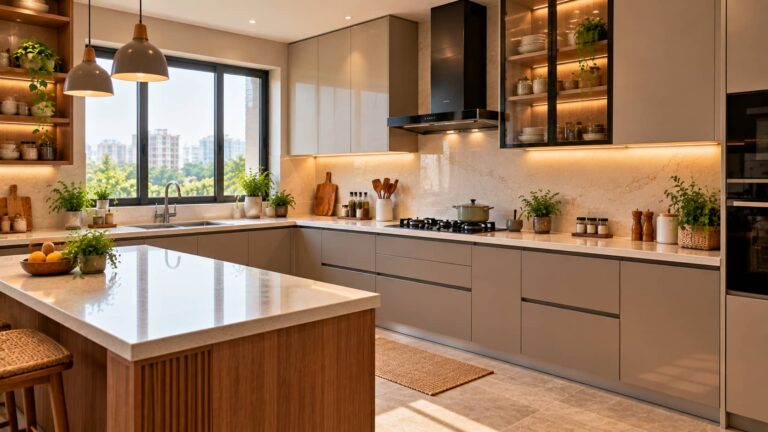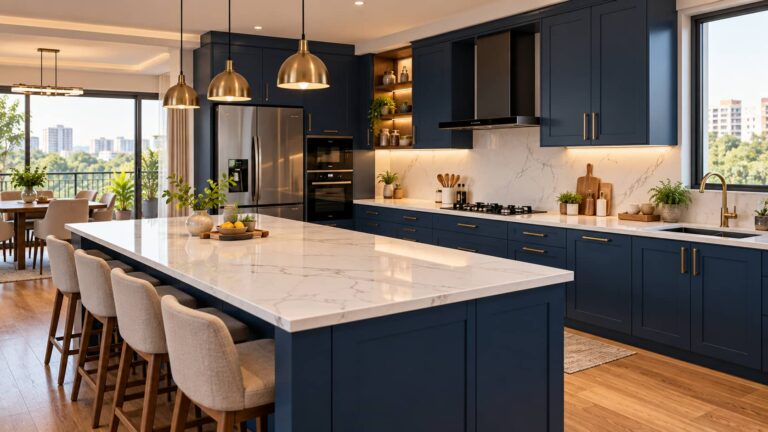
Your kitchen countertop looks simple but daily Indian cooking can put it through a serious test. Hot tawas, sizzling kadais, turmeric, oil, tea, coffee and constant cleaning can quickly reveal whether your choice was right. So, quartz vs granite: which one actually makes more sense for a Bangalore kitchen? The answer isn’t as straightforward as “quartz is modern” or “granite is stronger.” Heat, stains, maintenance, price, cooking habits and even installation quality can change the decision. Before you choose, here’s what you need to know.
How We Compared Quartz and Granite
We compared quartz and granite based on the factors that matter most in an everyday kitchen: heat resistance, stain resistance, maintenance, scratch resistance, appearance, cooking habits and overall cost. For Bangalore homeowners, we also considered practical factors such as local pricing, fabrication, installation and the way Indian kitchens are typically used.
What Is Granite?
Granite is a natural stone valued for its durability, heat resistance and distinctive appearance. Formed deep within the earth, it contains minerals such as quartz, feldspar and mica, which create the unique colours, grains and patterns seen across different slabs. Unlike engineered surfaces, granite offers natural variation, so each slab can have its own character. It is especially well suited to busy Indian kitchens, where frequent cooking and exposure to hot cookware make strength and heat resistance important considerations when choosing a countertop.
What Is Quartz?
Quartz is an engineered surface made primarily from quartz particles combined with resins, binders and pigments, giving manufacturers greater control over colour, pattern and finish. This makes quartz a popular choice for modern modular kitchens, especially when homeowners want clean whites, subtle greys or marble-inspired designs with a consistent appearance. Its non-porous surface helps resist everyday stains and simplifies cleaning. However, quartz is not designed for direct extreme heat, so hot tawas, kadais and vessels should always be placed on a trivet or heat pad.
Quartz vs Granite for Indian Cooking
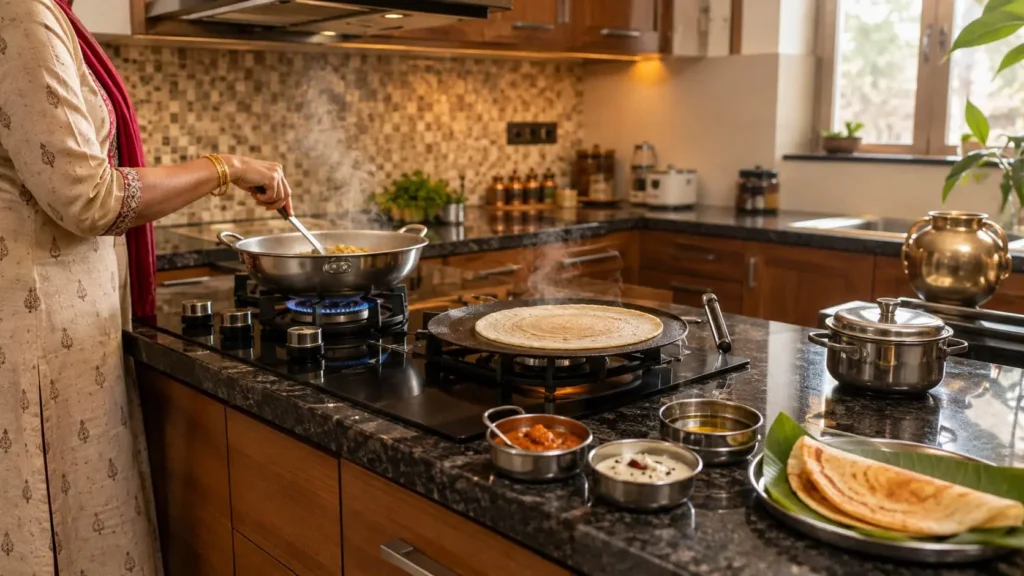
This is where the comparison gets more interesting.
A countertop that works perfectly in a lightly used kitchen may behave differently in a home where cooking happens several times a day.
Think about your typical kitchen:
- A hot dosa tawa comes off the stove.
- A kadai filled with curry needs somewhere to rest.
- Turmeric gets spilled.
- Oil splashes near the hob.
- Tea or coffee sits on the counter.
- Wet vessels are placed beside the sink.
- Vegetables are chopped throughout the day.
Hot Vessels: Granite Wins
When it comes to heat, granite has the upper hand. In a busy Indian kitchen, where a hot tawa, kadai or pressure cooker may come straight off the stove, granite is generally the more forgiving choice. Quartz needs a little more care because the resin used in engineered quartz can be affected by excessive heat. A simple trivet solves the problem, but if your family often places hot vessels directly on the kitchen platform, granite is the safer and more practical option.
Turmeric, Oil and Masala: Quartz Wins on Convenience
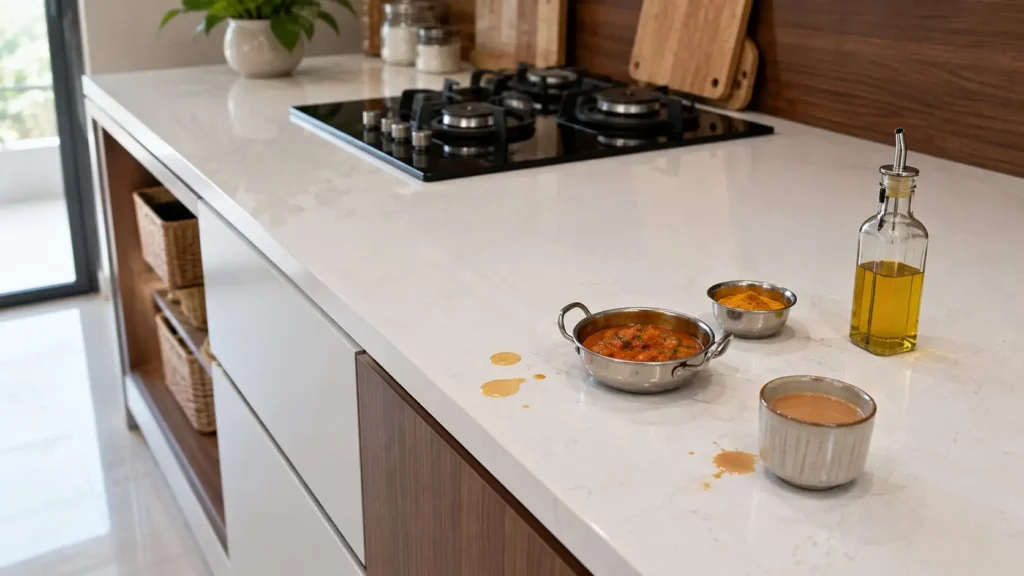
When it comes to everyday kitchen stains, quartz has a clear advantage. Its non-porous surface makes it highly resistant to turmeric, oil, curry, tomato and other common spills. Granite can also perform very well, but its porosity varies from one stone to another, so some varieties benefit from proper sealing. Whichever countertop you choose, don’t let spills sit for hours. Wipe turmeric, oil or acidic foods soon after they spill it’s one of the simplest ways to keep your countertop looking clean for years.
Chopping: Neither Should Be Your Cutting Board
Both quartz and granite are tough enough to handle everyday kitchen use, but neither is meant to be your chopping board. Cutting directly on the countertop can dull your knives and, over time, affect the surface finish. A simple chopping board is all you need to protect both your countertop and your knives. It’s a small habit, but one that can make a noticeable difference to how your kitchen platform looks and performs over the years.
Quartz vs Granite Price in Bangalore
If you’re planning the complete project budget, understanding the interior design cost in Bangalore can also help you decide how much of your budget should go toward the kitchen countertop.
There isn’t one fixed quartz price in Bangalore or one fixed granite price in Bangalore.
The final amount depends on:
- Material and grade
- Brand
- Thickness
- Finish
- Slab size
- Fabrication
- Edge profile
- Sink cut-outs
- Hob cut-outs
- Transportation
- Installation
- Wastage
- GST and other applicable charges
Recent Bangalore supplier listings put standard installed quartz broadly around ₹280–₹560 per sq. ft., while premium quartz can reach ₹550 ₹1,000+ per sq. ft. depending on the product and brand. One local supplier lists standard 20 mm quartz material around ₹360 ₹440 per sq. ft.
Other 2026 Indian market guides show a much wider range for both materials, reinforcing an important point: there is no single market rate that applies to every kitchen.
Granite generally gives homeowners greater price flexibility because locally available varieties can start at comparatively low prices, while premium and imported stones can become considerably more expensive.
Don't Compare Only the Square-Foot Rate
Don’t choose a countertop just because one supplier gives you a lower per-square-foot rate. For example, ₹350 may look better than ₹450, but what exactly is included in those prices? One quote might cover only the slab, while the other may already include fabrication, transportation, cut-outs, edge finishing and installation. Before comparing, ask both suppliers for the final installed cost. That is the number that actually matters when you’re planning your kitchen budget and it can be very different from the headline material price.
What Should Your Bangalore Countertop Quote Include?
Before paying an advance, get these items in writing:
- Material name and grade
- Slab thickness
- Rate per sq. ft.
- Fabrication charges
- Installation charges
- Transportation
- Sink cut-out
- Hob cut-out
- Edge profile
- Wastage
- GST
- Warranty, if applicable
This can prevent an attractive initial quote from becoming an expensive final bill.
Heat, Stains, Scratches and Maintenance: Head-to-Head
Heat Resistance
If your kitchen regularly sees hot tawas, kadais or pressure cookers, granite is the safer choice for direct heat. Quartz can handle everyday cooking well, but very hot cookware should be placed on a trivet or heat pad.
Stain Resistance
Quartz has the edge when it comes to stain resistance. Its non-porous surface makes everyday spills easier to manage, while granite can also perform exceptionally well when the right stone is properly sealed. If turmeric, oil and curry spills are part of your daily cooking, quartz offers added peace of mind.
Scratch Resistance
Both quartz and granite are highly resistant to everyday scratches, so either can handle normal kitchen use. But don’t mistake durability for being scratch-proof. Use a chopping board instead of cutting directly on the countertop. It’s better for both the surface and your knives.
Maintenance
Quartz has the advantage here. Its non-porous surface generally doesn’t require routine sealing, making everyday care simple. Granite is also easy to maintain, but depending on the stone’s porosity, periodic sealing may be recommended.
Natural Appearance
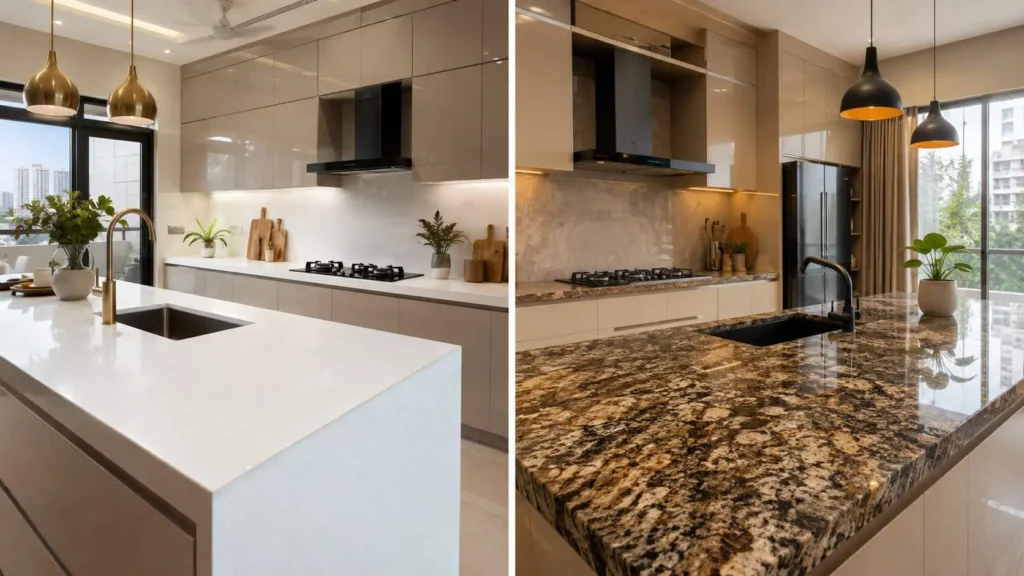
Granite stands out for natural beauty. Every slab has its own mineral patterns, colour variations and movement. If you want a countertop with a genuinely natural character rather than a perfectly uniform look, granite is hard to beat.
Consistent Appearance
Quartz is the better choice for design consistency. If you already have a specific colour, pattern or modern kitchen concept in mind, quartz makes it easier to achieve a predictable look across the countertop.
Quartz vs Granite: Which Looks Better?
This comes down to personal taste and the interior design style you want to create throughout your home.
Before choosing a countertop colour or pattern, it can be useful to decide whether your home will follow a modern, minimalist, traditional or transitional interior design approach.
Granite has a natural depth that is difficult to reproduce exactly. The mineral variation can make the countertop feel like a feature rather than simply a functional surface.
Quartz takes a different approach.
Its controlled manufacturing allows clean, consistent patterns and colours. Marble-inspired quartz has also become popular in contemporary kitchens because it can create a sophisticated appearance without the maintenance associated with some natural stones.
Choose Granite If You Want:
- Natural variation
- Organic patterns
- A unique slab
- Traditional or contemporary styling
- A strong natural-stone appearance
Choose Quartz If You Want:
- Consistent colour
- Minimalist design
- Modern aesthetics
- White or light-coloured surfaces
- Marble-inspired patterns
- Easy coordination with modular cabinets
Tip: Don’t choose your countertop from a tiny sample alone.
For granite especially, ask to see the actual slab. The full slab can have significantly more movement and colour variation than a small showroom sample suggests.
Which Is Better for a Modular Kitchen?
Both quartz and granite can look excellent in a modular kitchen. The real choice comes down to your lifestyle and the look you’re trying to create. If you’re still planning the layout, storage and materials, choosing the right modular kitchen design can help you select a countertop that works with the entire space. Quartz suits clean, contemporary designs where consistent colours and easy maintenance matter. Granite works beautifully when you want natural variation, strong heat resistance and a more distinctive stone character.
Quartz for a Modern Modular Kitchen
For homeowners planning a contemporary kitchen, keeping up with the latest kitchen design trends can also help you decide whether quartz or granite will work better with your cabinets, backsplash and overall colour scheme.
Quartz works particularly well with:
- Handleless cabinets
- White kitchens
- Grey kitchens
- Minimalist designs
- Flat-panel shutters
- Contemporary hardware
- Clean backsplash designs
Its consistent appearance makes the overall kitchen easier to coordinate. This is particularly useful when you’re planning interior colour combinations for the cabinets, walls, backsplash and countertop together.
Granite for a Modular Kitchen
Want a countertop that combines natural character with everyday durability? Granite is a practical choice for modern modular kitchens, especially for homeowners who value heat resistance and design flexibility.
- Natural stone character
- High heat tolerance
- Greater material-price flexibility
- A visually distinctive countertop
- A traditional or transitional appearance
A well-selected granite can look equally premium in a modern kitchen.
Which Is Better for Heavy Cooking?
If your kitchen handles heavy daily cooking, granite has a practical edge because of its strong heat resistance. Think about a hot dosa tawa, a kadai straight from the stove, or a pressure cooker being moved across the platform. These are everyday situations in many Indian homes. Quartz can still work very well, but it needs one simple precaution: don’t place extremely hot cookware directly on the surface. If your family regularly forgets the trivet, granite is the more forgiving choice.
Which Is Easier to Maintain?
Quartz has the advantage when low maintenance is your priority. For everyday cleaning, a mild cleaner or simple soap and water is usually enough. Granite is also easy to care for, but depending on the stone, it may need periodic sealing to maintain its resistance to stains.
The difference isn’t that granite is difficult to maintain; quartz simply gives you one less thing to worry about.
If your ideal routine is install → use → wipe → repeat, quartz is hard to beat. But if you’re happy with occasional maintenance and prefer natural stone with greater heat tolerance, granite remains a practical choice.
Don't Ignore the Fabricator
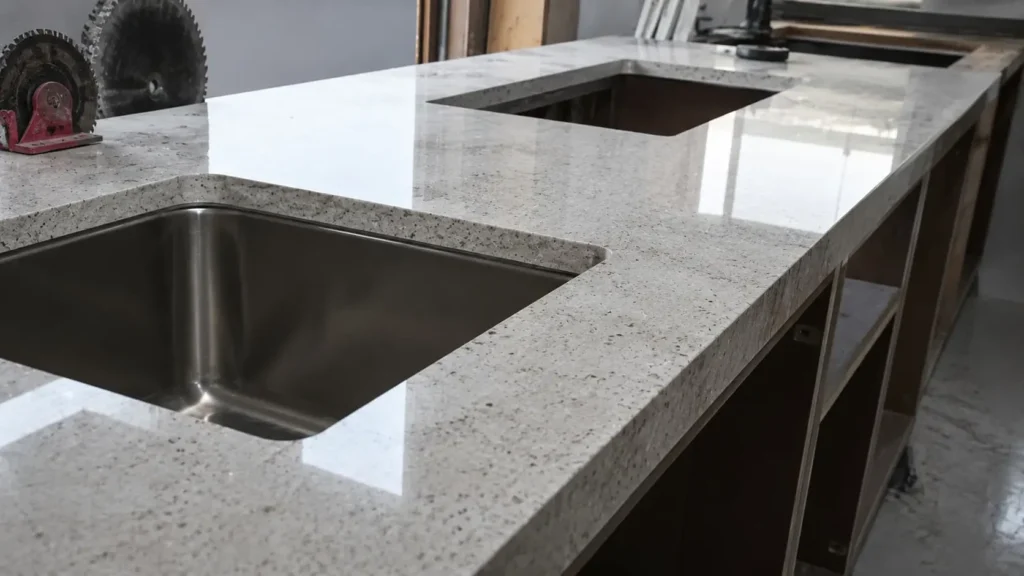
Choosing a good quartz or granite slab is only half the job. The kitchen materials used for the cabinets, carcasses and supporting structures also influence the durability and overall quality of the finished kitchen. The quality of fabrication and installation can have just as much impact on how your countertop looks and performs over time.
The middle of the slab is rarely the biggest concern. Problems are more likely around sink and hob cut-outs, corners, seams, edges and unsupported overhangs. Proper cabinet support and accurate fabrication are especially important because both quartz and granite are heavy materials.
Before finalising your fabricator, don’t just ask for the lowest quote. Ask to see a few completed kitchens. Check how neatly the seams are joined, how the edges are finished, and how the fabricator has handled sink cut-outs and overhangs.
A cheaper slab with poor workmanship can end up costing more than a well-installed countertop from an experienced fabricator. When comparing quotes, you’re not just buying stone, you’re paying for the quality of the finished kitchen.
7 Questions to Ask Before Buying
Before you choose quartz or granite, look beyond the colour and price. These seven questions will help you match the countertop to your cooking habits, maintenance needs, budget and overall kitchen design.
1. Do we cook heavily every day?
If your kitchen handles frequent cooking, frying and multiple dishes, granite’s stronger heat resistance can make it a more forgiving choice.
2. Do we regularly place hot vessels on the counter?
If hot tawas, kadais or pressure cookers often go straight onto the platform, granite offers greater peace of mind. Quartz needs heat protection.
3. Do I want minimal maintenance?
If you prefer a countertop that is simple to clean and generally doesn’t require routine sealing, quartz is the more convenient option.
4. Do I want genuine natural stone?
If natural mineral patterns, colour variation and the character of a unique slab matter to you, granite is the obvious choice.
5. Do I have a specific colour or design in mind?
Quartz offers more predictable colours and patterns, making it easier to coordinate the countertop with modern cabinets, backsplashes and flooring.
6. Am I working with a limited budget?
Compare several granite varieties before deciding. Granite offers a wider range of price points, although premium varieties can also become expensive.
7. Am I comparing the complete installed cost?
Don’t compare slab prices alone. Ask whether fabrication, transportation, cut-outs, edge finishing, installation and taxes are included in the quotation.
Quartz or Granite: Which One Should You Choose?
Still unsure which countertop is right for you? Use this simple guide to match quartz or granite with the way you cook, clean, and use your kitchen every day.
Choose Quartz If:
- You want low maintenance.
- You want excellent stain resistance.
- You prefer consistent colours and patterns.
- You have a modern modular kitchen.
- You like white, grey or marble-inspired designs.
- Your family can use trivets for hot cookware.
- You don’t want to worry about periodic sealing.
Choose Granite If:
- You do heavy cooking.
- Hot cookware is regularly handled.
- Heat resistance is a priority.
- You prefer natural stone.
- You want unique slab patterns.
- You want more flexibility across price ranges.
- You don’t mind periodic sealing when required.
Quartz vs Granite: Which One Fits Your Needs?
| Your Priority | Better Suited | Why |
|---|---|---|
| Low maintenance | Quartz | Generally requires less routine maintenance |
| Stain resistance | Quartz | Non-porous surface helps with everyday spills |
| Direct heat exposure | Granite | Better suited to high heat |
| Heavy cooking | Granite | More forgiving around hot cookware |
| Natural stone | Granite | Natural mineral variation in every slab |
| Consistent colour | Quartz | Manufactured for predictable appearance |
| Modern minimalist design | Quartz | Clean and consistent patterns |
| Budget flexibility | Granite | More price variation across stone types |
| Unique slab appearance | Granite | Natural variation makes each slab different |
| Marble-inspired appearance | Quartz | Consistent engineered patterns are available |
Conclusion
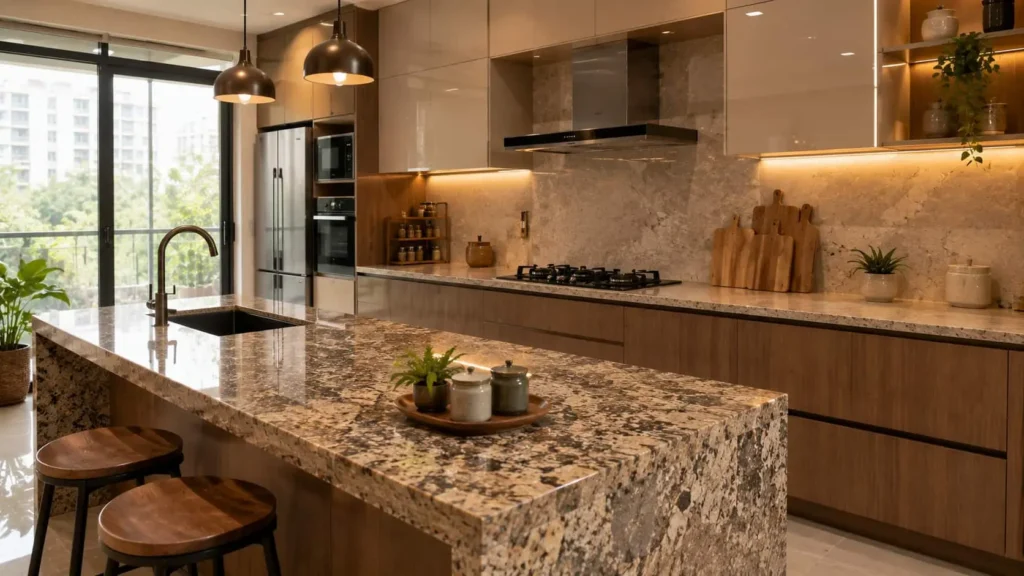
So, quartz or granite which is better? There’s no universal winner. Choose quartz if you want low maintenance, excellent stain resistance and a consistent modern look. Choose granite if you prioritise natural stone, greater heat resistance, heavy cooking and budget flexibility. Before deciding, compare more than the slab price check thickness, fabrication, cut-outs, edge finishing, installation and the complete quotation. Ultimately, the best countertop is the one that fits your cooking habits, kitchen design, budget and everyday lifestyle.
Frequently Asked Questions
Is quartz better than granite for Indian kitchens?
It depends on how the kitchen is used. Quartz is excellent for stain resistance and low maintenance, while granite has an advantage when direct heat and heavy cooking are major concerns.
Does quartz scratch easier than granite?
Both are highly scratch resistant. Neither should be used as a chopping board, so use a separate cutting board for food preparation.
Can I put a hot tawa directly on quartz?
It is best not to. Very hot cookware can damage or discolour resin-containing engineered quartz. Use a trivet or heat pad.
Does granite need sealing?
Some granite varieties benefit from periodic sealing, but the exact requirement depends on the stone’s porosity and the sealer used. Ask your supplier or fabricator for the manufacturer’s maintenance recommendation.
Which is cheaper in Bangalore: quartz or granite?
There is no universal answer. Budget granite can be considerably cheaper than premium quartz, but premium granite can also become expensive. Compare the complete installed quotation rather than just the material rate.
What is the best countertop for a modular kitchen?
Quartz is an excellent choice when low maintenance and consistent modern aesthetics are priorities. Granite is equally suitable when heat resistance, natural stone and budget flexibility matter more.