When planning a modular kitchen, the finish is usually the first thing you notice, but the board underneath it determines much of the kitchen’s long-term performance. In a humid city such as Bangalore, moisture around the sink, steam from cooking and occasional leaks make material selection especially important.
For most modular kitchens, BWP-grade plywood is the safest all-round choice for the cabinet carcass, particularly around the sink and other wet areas. For dry sections, BWR plywood can offer a sensible balance between cost and moisture resistance, while MDF or other engineered boards can work well for selected shutters and decorative applications. Solid wood is best treated as a design choice rather than the default structural material.
The key is not to use the most expensive material everywhere. It is to use the right material in the right part of the kitchen. A well-planned modular kitchen interior design also considers layout, storage, functionality and daily usage.
What Is the Best Wood for a Modular Kitchen?
If by “wood” you mean the material used to build the cabinet boxes, plywood is generally the most practical choice for a high-quality modular kitchen. It offers a useful combination of strength, screw-holding ability, dimensional stability and moisture resistance when the appropriate grade is selected.
For a typical Bangalore home, a sensible material strategy is:
| Kitchen Component | Practical Material Choice | Why |
|---|---|---|
| Base Cabinet Carcass | BWP Plywood | Better protection against moisture and spills |
| Sink Cabinet | BWP Plywood / Marine Plywood | Highest moisture exposure |
| Upper Cabinets | BWP or Good BWR Plywood | Less direct water exposure |
| Tall Units | BWP/BWR Plywood | Depends on location and load |
| Shutters | Plywood, MDF/HDMR or Solid Wood | Depends on finish and design |
| Drawer Boxes | Good-Quality Plywood or Specified Engineered Board | Strength and repeated use |
| Decorative Panels | MDF/HDMR Can Be Suitable | Smooth machining and painted finishes |
| Premium Natural-Wood Look | Solid Hardwood or Veneer Over Plywood | Appearance rather than waterproofing |
There is an important distinction here: BWP and marine plywood are not simply two names for exactly the same specification. The current Indian standards distinguish them. IS 303:2024, the fourth revision of the general-purpose plywood standard, includes MR, BWR and BWP grades. IS 710:2024 is the separate standard for marine plywood.
That distinction matters when you are comparing quotations. A contractor saying “710 grade” and another saying “BWP” may not be offering identical specifications.
Why Plywood Is Usually the Best Material for Modular Kitchens
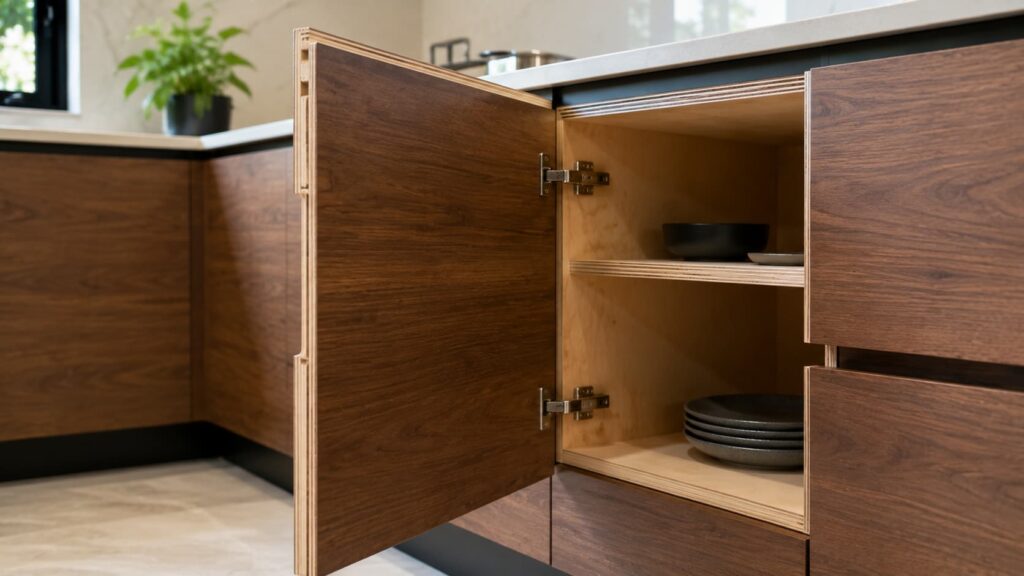
A modular kitchen has to deal with more than just weight. Cabinet panels are repeatedly drilled, screwed, hinged and loaded with utensils, appliances and food containers. They also encounter humidity, steam and occasional water exposure.
Good-quality plywood is made from layers of wood veneer arranged with alternating grain directions. This construction gives the panel useful dimensional stability and strength compared with many lower-cost wood-based boards.
The other advantage is repairability. If a hinge, drawer runner or accessory needs to be replaced, a properly made plywood cabinet generally provides a reliable substrate for repeated fastening. The actual performance still depends on the plywood’s construction, thickness, manufacturing quality and installation.
This is why simply asking a dealer for “the best wood” is not enough. You should ask:
- What board is being used?
- What grade is it?
- Which BIS standard does it comply with?
- What thickness is specified?
- Where will each grade be used?
- How are exposed edges protected?
- What happens if water reaches the cabinet base?
The last question is particularly useful. A good material can still fail prematurely if the installation leaves exposed edges, poor joints or water traps.
Best Plywood for Modular Kitchen in India: BWP, BWR or MR?
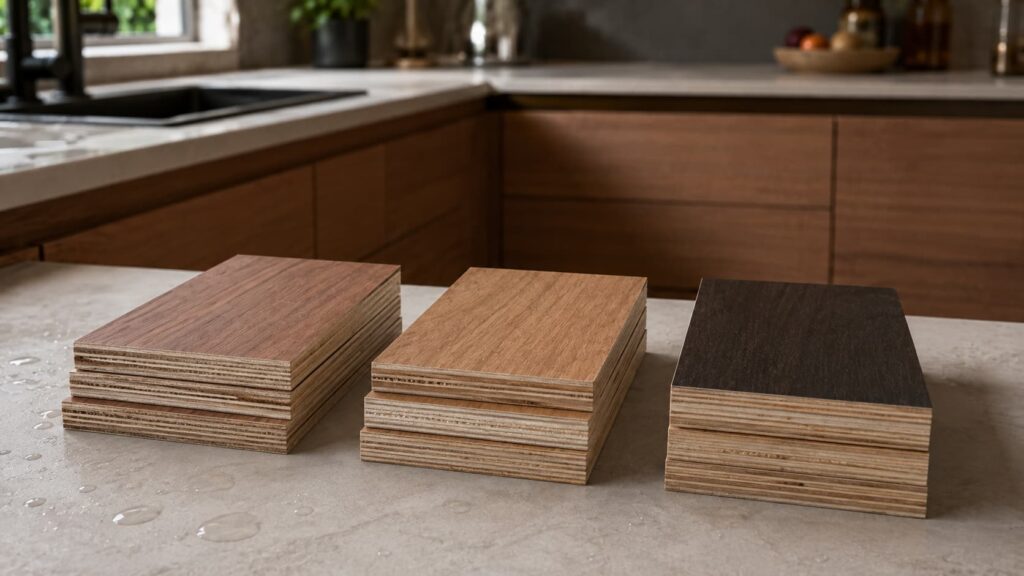
The three terms that commonly appear in Indian plywood discussions are MR, BWR and BWP.
Their names describe their resistance to moisture, but they should not be treated as interchangeable labels.
BWP plywood
BWP stands for Boiling Water Proof. Under the current IS 303:2024 framework, BWP is one of the recognized grades of general-purpose plywood. BIS testing information for the revised standard includes separate MR, BWR and BWP grades and water-resistance testing.
For a modular kitchen, BWP is generally the strongest default choice where moisture is a serious concern.
It is particularly appropriate for:
- Sink cabinets
- Base cabinets close to plumbing
- Cabinets likely to experience spills
- Areas with repeated cleaning
- Moisture-prone sections of the kitchen
However, “BWP” should not be interpreted as permission to leave the cabinet permanently exposed to standing water. Water can still enter through poorly sealed edges, joints, cut-outs and hardware holes.
BWR plywood
BWR means Boiling Water Resistant. It is a step up from conventional MR plywood in moisture resistance and can make sense in parts of the kitchen that experience humidity or occasional moisture but aren’t directly exposed to water.
For example, an upper cabinet well away from the sink may not need the same specification as the cabinet directly below a leaking sink trap.
BWR can therefore be a reasonable cost-conscious choice when the kitchen is divided into dry and wet zones.
MR plywood
MR means Moisture Resistant. It is intended for environments where moisture exposure is relatively limited. BIS’s plywood standards distinguish MR from the more water-resistant grades.
MR plywood can be perfectly sensible for dry furniture applications, but using it indiscriminately throughout a kitchen is a false economy if particular cabinets are likely to encounter regular water exposure.
For a kitchen renovation, the better question isn’t “Is MR plywood bad?” It is:
“Where exactly is the MR plywood going?”
If the answer is “under the sink,” that should trigger another conversation with the contractor.
BWP vs MR Plywood for Kitchen: Which Is Better?
For kitchen cabinetry exposed to moisture, BWP is the better choice. MR plywood is intended for lower-moisture applications and generally makes more sense when the board is protected from direct or repeated water exposure.
| Factor | MR Plywood | BWP Plywood |
|---|---|---|
| Moisture Resistance | Lower | Higher |
| Suitable for Dry Furniture | Yes | Yes |
| Suitable for Kitchen | Selectively | Yes |
| Sink Cabinet | Poor Choice | Preferred |
| Cost | Usually Lower | Usually Higher |
| Best Use | Dry Sections | Moisture-Prone Sections |
The important point is that upgrading every single panel to the highest specification may not always deliver proportional value.
For example, if your kitchen has a tall pantry cabinet far from the sink and a heavily exposed sink unit, spending more on the sink unit’s moisture protection is usually more meaningful than blindly specifying the same material without considering the environment.
Which Plywood Is Best for Kitchen Cabinets?
For most homeowners looking for a durable modular kitchen, good-quality BWP plywood is the strongest general recommendation for the carcass.
But grades alone don’t tell you whether a particular sheet is good.
Before approving the material, check:
1. The applicable BIS standard
Do not rely solely on phrases such as “waterproof,” “marine quality” or “premium plywood” printed in a quotation.
Ask for the exact standard and grade. Current BIS information lists IS 303:2024 for general-purpose plywood and IS 710:2024 for marine plywood.
2. The actual thickness
Kitchen carcasses commonly use relatively thick panels because they have to support shelves, drawers, hardware and stored loads. Around 18 mm is a common specification for cabinet carcasses, although the correct thickness depends on the design and construction method.
Do not assume that a thicker sheet automatically means better plywood. A poor-quality thick panel is still a poor-quality panel.
3. Core construction
Look at the exposed edge of a sample. The veneer layers should appear reasonably consistent rather than showing excessive gaps, loose sections or obvious voids.
Core quality matters because it affects strength, screw holding and the behaviour of cut edges.
Do not assume that a thicker sheet automatically means better plywood. A poor-quality thick panel is still a poor-quality panel.
4. Moisture protection after cutting
Even water-resistant plywood isn’t a substitute for good detailing.
Sink cut-outs, screw holes, exposed edges and joints need appropriate protection. The cabinet should also be designed so that a small plumbing leak does not leave water trapped against the board for days.
This is one of the most overlooked aspects of kitchen construction. Proper interior design space planning can also help ensure that the kitchen layout, storage and material choices work together efficiently.
Marine Plywood for Kitchen: Is It Necessary?
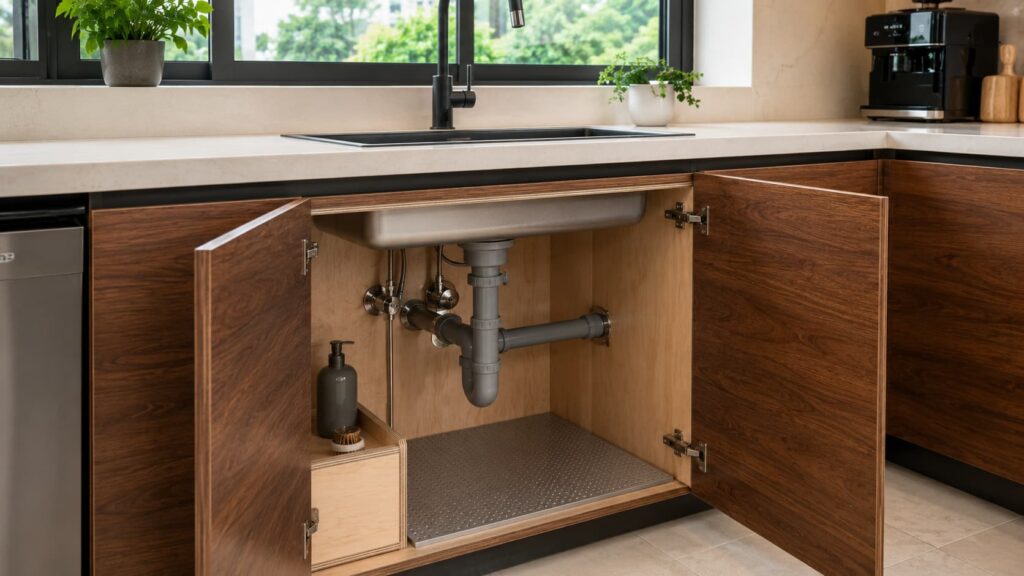
Marine plywood is manufactured to the requirements of IS 710, a dedicated Indian Standard for marine plywood. The current IS 710:2024 specification includes requirements relating to dimensions, moisture content, water resistance, glue adhesion, strength, mycological testing and formaldehyde-related requirements.
That makes IS 710 marine plywood a high-specification option for moisture-prone applications.
But there is an important practical distinction:
A residential kitchen does not automatically require every cabinet to be made from marine plywood simply because marine plywood has excellent water resistance.
If the quotation offers IS 710 marine plywood at a significant premium, ask where it is actually needed.
For example, it can make particular sense for:
- Sink units
- Areas with recurring plumbing exposure
- Extremely moisture-prone locations
- Applications where maximum water resistance is a priority
Before finalising your kitchen materials, you can also compare marine plywood vs commercial plywood to understand which option is more suitable for your requirements.
MDF vs Plywood for Modular Kitchen
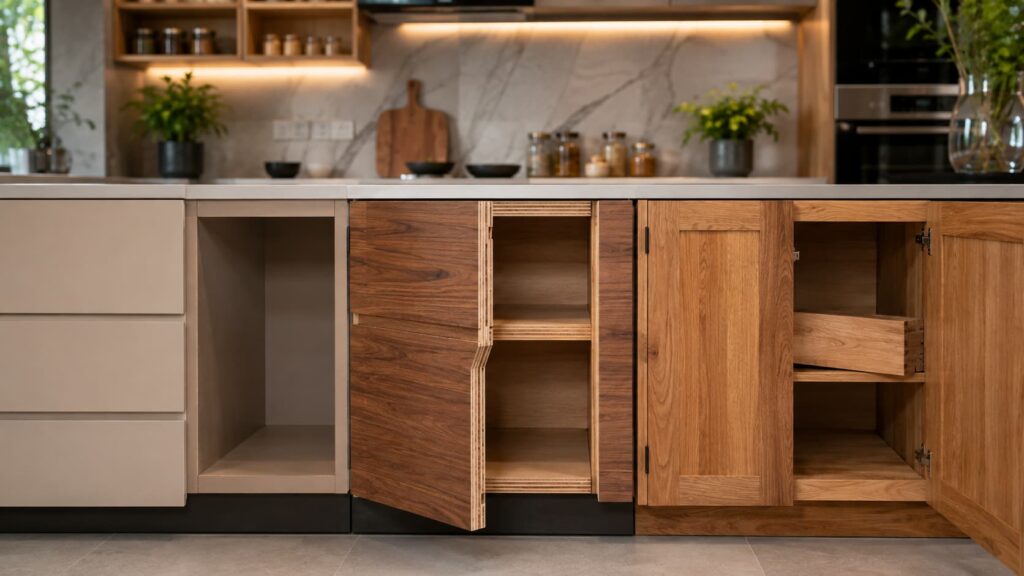
MDF is often discussed as though it is automatically inferior to plywood. That isn’t accurate.
MDF medium-density fibreboard is an engineered wood product made from wood fibres. BIS currently lists IS 12406:2021 for medium-density fibreboards for general-purpose applications, including testing for properties such as density, moisture content, thickness swelling, internal bond strength, bending properties and screw withdrawal strength.
The better question is where MDF is being used.
MDF has a smooth, uniform surface and is particularly useful for painted or routed components. It can produce clean decorative profiles and is popular for certain shutter designs.
Plywood, meanwhile, is generally the safer structural choice where the cabinet has to deal with significant loads, repeated fastening and moisture exposure.
MDF makes sense when:
- A smooth painted finish is required
- Decorative routing is important
- The component is in a relatively dry location
- The manufacturer specifies an appropriate moisture-resistant board for the application
Plywood makes more sense when:
- The panel forms the cabinet carcass
- Heavy hardware is being installed
- The cabinet is near plumbing
- Moisture exposure is significant
- Long-term screw holding is important
The right furniture selection and customization can further help match the kitchen’s storage requirements, design preferences and available space.
Solid Wood vs Plywood for Kitchen Cabinets
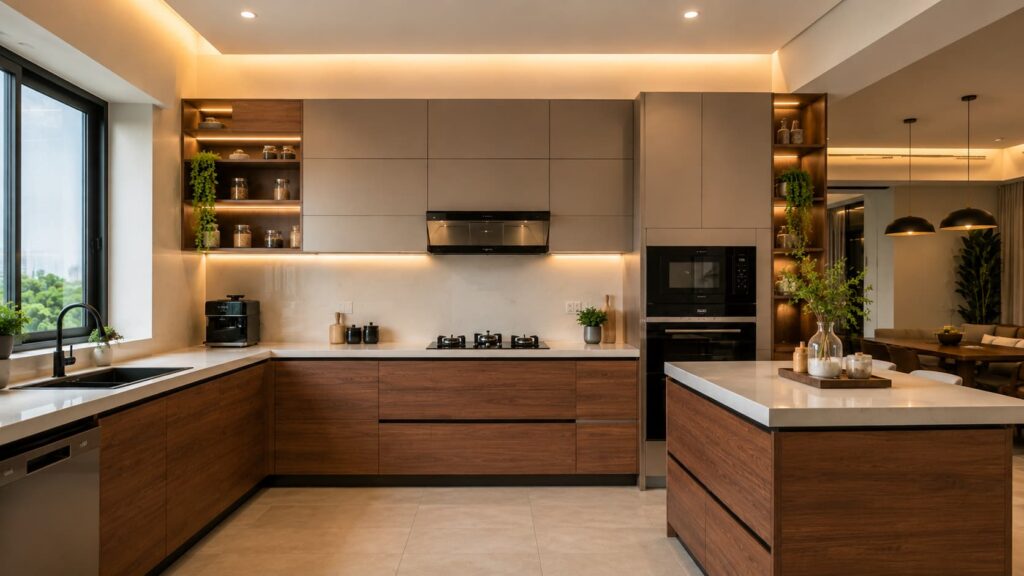
| Solid Wood | Plywood |
|---|---|
| Natural grain and character | Consistent engineered panel |
| Premium appearance | Easier to cover with laminate/veneer |
| Can be expensive | Wider range of price points |
| Can move with humidity | Generally more dimensionally stable |
| Excellent for feature elements | Practical for cabinet carcasses |
| Requires appropriate seasoning and finishing | Grade and construction are easier to specify |
For a modular kitchen, a strong combination can be plywood for the cabinet structure with natural-wood veneer or selected solid wood for visible design elements.
That gives you the appearance of timber without making the entire cabinet dependent on solid-wood construction.
What Is the Best Material for a Modular Kitchen?
Plywood isn’t the only material available. Depending on the design, budget and location, a kitchen can include plywood, MDF, HDMR-type boards, particle boards, solid timber and other engineered materials.
The mistake is treating one material as universally superior.
A better material hierarchy is based on exposure and function:
Wet structural zone: BWP plywood is a strong choice.
General structural cabinetry: Good BWP or BWR plywood, depending on the moisture risk and budget.
Dry decorative shutters: Plywood, MDF or an appropriate high-density engineered board can work.
Natural premium appearance: Veneer over a stable substrate or properly prepared solid wood.
BIS also maintains separate standards for different wood-based panels, reinforcing the point that these are distinct material categories rather than interchangeable products.
The Most Important Kitchen Detail: Water Management
People often spend considerable time comparing plywood brands and grades but overlook the actual source of kitchen damage.
A sink cabinet can be made from excellent BWP plywood and still suffer if:
- The sink plumbing leaks
- The cabinet base collects standing water
- Cut-outs aren’t protected
- Edges remain exposed
- The plinth traps moisture
- Water repeatedly enters through poorly sealed joints
- The laminate or edge banding is badly installed
Think of plywood as one part of a moisture-management system.
The cabinet design should prevent water from sitting against the board. Exposed edges should be appropriately sealed or edge-banded, and plumbing should remain accessible enough to inspect and repair.
This matters more than simply upgrading from one premium plywood brand to another while ignoring poor installation.
How to Check Plywood Before Buying
If you’re comparing quotations from interior designers or contractors in Bangalore, don’t just compare the final kitchen price.
Ask for a material specification sheet or BOQ that clearly states:
- Brand
- Product/range
- Applicable IS standard
- Grade
- Thickness
- Where each grade will be used
- Edge-banding specification
- Back-panel specification
- Hardware specification
- Warranty terms
Most importantly, make sure the quotation does not simply say “18 mm plywood”.
Two 18 mm sheets can represent very different specifications.
Also ask the contractor to show the plywood before fabrication begins. Check the markings, grade and thickness rather than assuming that whatever was promised in the quotation is what will arrive at the workshop.
BIS’s current information confirms that plywood standards include requirements covering dimensions, moisture content, water resistance, strength and other properties, so certification and specification are more meaningful than vague marketing descriptions.
Common Mistakes to Avoid
Choosing the cheapest plywood for the entire kitchen
Saving money is sensible. Saving money specifically on the cabinet material most exposed to water is less sensible.
Use the budget strategically instead of applying the cheapest grade everywhere.
Assuming “waterproof” means maintenance-free
No plywood should be treated as permission for standing water, leaking plumbing or permanently wet cabinet interiors.
Confusing BWP with marine plywood
The current BIS standards make the distinction clear: IS 303:2024 covers general-purpose plywood including BWP, while IS 710:2024 is the dedicated marine plywood standard.
Ask exactly what standard is being offered.
Choosing MDF solely because it looks smooth
A smooth board may be excellent for a painted shutter but isn’t automatically the best material for a sink cabinet.
Focusing only on the plywood brand
Brand matters, but so do grade, certification, construction, thickness and installation quality.
Ignoring the back and edges
The front of a kitchen cabinet may be beautifully laminated while the less visible edges and cut-outs remain vulnerable to moisture.
A Practical Specification for a Bangalore Modular Kitchen
There is no single specification that fits every home, but a sensible starting point for discussion with your interior designer is:
- Cabinet carcass: good-quality BWP plywood
- Sink cabinet: BWP or IS 710 marine plywood where the higher specification is justified
- Upper cabinets: BWP or BWR depending on moisture exposure and budget
- Shutters: plywood, MDF/HDMR-type board or solid wood depending on finish
- Drawer construction: good-quality plywood or a specified engineered system
- Edges: properly sealed/edge-banded, especially around wet areas
- Plumbing: accessible and designed to minimise standing water
- Hardware: specified separately rather than assumed to be included
- Certification: verify the applicable BIS standard and grade
Treat these as design recommendations, not universal BIS requirements. Cabinet dimensions, loads, shutter construction, hardware and the designer’s system can change the appropriate specification.
So Which Wood Is Best for a Modular Kitchen?
For most homeowners asking which wood is best for a modular kitchen, the answer is not a particular species of timber.
It is good-quality, appropriately certified plywood matched to the kitchen’s moisture exposure.
If you want one straightforward choice for the structural cabinetry, BWP plywood is the practical default. If the budget requires optimisation, use the highest moisture-resistant specification where water exposure is greatest rather than paying a premium everywhere.
For dry decorative shutters, MDF or another suitable engineered board can make sense. For a natural luxury appearance, solid wood or veneer can be added where it provides genuine aesthetic value.
The best kitchen is therefore not the one with the most expensive board. It is the one where material, grade, thickness, hardware and moisture protection have been specified together.
Conclusion
If you’re planning a modular kitchen in Bangalore, start by mapping the kitchen into wet and dry zones. Use BWP plywood where moisture exposure is highest, consider BWR where the risk is moderate, and reserve MDF or other engineered boards for applications where their particular advantages such as a smooth painted finish actually matter.
If you’re planning a kitchen as part of a complete home interior project, understanding the interior design cost in Bangalore can also help you plan your material, finish and furniture budget more effectively.
FAQs
Which plywood is best for a modular kitchen?
For most modular kitchens, BWP grade plywood is a strong general-purpose choice, particularly for base and sink cabinets. The exact standard should be verified rather than relying only on the word “BWP.”
Is BWP plywood better than MR plywood for a kitchen?
Yes, where moisture exposure is significant. BWP provides greater water resistance than MR plywood and is therefore better suited to wet kitchen zones. MR plywood is more appropriate for relatively dry applications.
Is marine plywood necessary for a kitchen?
Not necessarily for every cabinet. IS 710 marine plywood is a high-specification option for moisture-prone applications, but a residential kitchen can often be specified more economically by using appropriate BWP plywood in the areas that need it most. IS 710 and IS 303:2024 are separate standards.
Can MDF be used for modular kitchen cabinets?
Yes, but its suitability depends on the application and the specific board. MDF can work well for selected shutters and decorative components, particularly where a smooth painted finish is required. Plywood is generally the more practical choice for moisture-exposed structural cabinetry.
Is solid wood better than plywood for kitchen cabinets?
Not automatically. Solid wood offers a premium natural appearance but can move with changes in moisture and temperature. Plywood is usually more practical for modular cabinet construction because it provides a stable engineered panel.
Which plywood is best for kitchen cabinets in India?
For moisture-prone cabinets, BWP plywood is a practical choice. When comparing products, check the actual BIS grade, applicable standard, thickness, core construction and manufacturer documentation rather than relying on marketing terms.
What is the best plywood for kitchen cabinets near the sink?
Use a high-quality BWP-grade plywood, with IS 710 marine plywood being another higher-specification option where justified. Proper sealing of edges, joints and plumbing cut-outs is equally important.
Is BWR plywood good for a modular kitchen?
It can be suitable for parts of a kitchen that experience humidity or occasional moisture but aren’t exposed to regular water. For sink units and other high-moisture locations, BWP is the safer choice.
What thickness of plywood is suitable for kitchen cabinets?
Around 18 mm is a common specification for cabinet carcasses, but the correct thickness depends on the cabinet design, dimensions, hardware and load. Thickness should therefore be specified in the BOQ rather than assumed to be universal.
How can I check whether the plywood specified by my contractor is actually being used?
Ask to inspect the sheets before fabrication and verify the manufacturer’s markings, grade, applicable BIS standard and thickness. Keep the material specification in writing as part of the quotation or work order.